[First published on July 2019, see on LinkedIn>>]
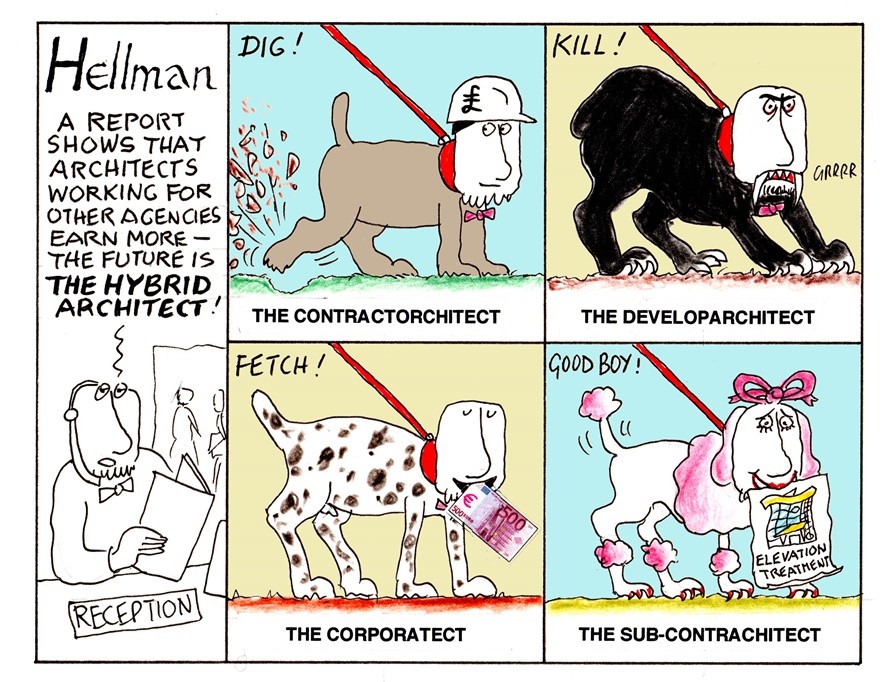
Once upon a time the architect.
This is the substance of Rab Bennetts’ article on AJ last year about novation.
I can’t agree more on considering delivery as an essential part of design and the habit of splitting the process in two parts (design and delivery, where the first goes from concept to planning and the second after planning to completion) as a phenomenon (novation) eroding the profession.
However, Bennetts put a double question “why is this happening and what can be done?”.
WHY?
Designing is getting more complicated: client expectations, rules and regulations, and required minimum performance made the design process far more complex compared with twenty years ago.
On the other side (details and execution), what the industry offers in terms of materials, systems, solutions, is incomparable with anything was available on the market just a decade ago.
The bright side is that potentially the average quality of the buildings (and the quality of an average building) should rise a lot. The downside is that to get that quality you have to manage a far more complex process.
When things are getting complicated, specialisation is the natural answer: someone for the design, somebody else for the delivery and execution.
WHO IS AFFECTED BY THE NOVATION?
Medium and large practices can easily manage the whole process because they can easily hire architects to work at different stages along the project, the most experienced working side by side with the youngest to keep pace with technology. From the client point of view there is no difference but, somehow, there could be a sort of hidden novation in there.
For small and medium practice, especially those with young architects, the only solution seems to have in-house one of those (rare) architects capable of mastering the craft of “meeting deadlines and budgets, not to mention fighting off those who would dumb down the design”, having that “experience, discipline and nous” who Bennetts describes so eloquently.
WHAT CAN WE DO?
In Italy, where I have my background, novation is not even known. Back there, the architect is still the Master, responsible for the whole process including compliance with building regulation and standard (Building Control companies or consultants don’t exist and full compliance has to be demonstrated with the planning application under architects’ responsibility).
At the University Italian students are prepared to face a profession which will require a wide range of skills and notions and, above all, the ability to manage complexity.
That’s the reason I am used to work from the concept throughout the stages assisting the site manager until the project is completed and it turns into a real building (architecture as “the art of making”).
Education at the University is a factor but not the only one since most comes from the experience on the field. Being exposed to construction issues is key.
HOW?
Bennets suggests “In-depth knowledge of construction and engagement with industry” as the factors to keep the profession’s reputation. Once more, I totally agree. The question is HOW to get that knowledge and engagement.
My professional choice in UK has been moving from a traditional architectural practice to a Main Contractor. The brand-new Architectural department at Avalon is now offering Design & Construction services (design+delivery+construction), fulfilling that continuity along the process which Bennetts claims for the sake of the profession.
Working with a contractor has been the natural evolution to me to find again that proximity with the construction I was missing in London because of the way the industry is organised in UK. I am not suggesting here that everybody should do the same.
However, to be exposed to construction issues, especially small and young architectural practices and architects should work more often side by side with contractors creating partnership and offering the client a full package of services. A partnership with a Contractor is the best way to gain that “in-depth knowledge of construction and engagement with the industry” described by Bennetts and it is also a good way to compete with larger practices.
INNOVATING THE PROCESS: SKIPPING THE TENDER, JUMPING TO CONSTRUCTION
The main task required at delivery stage is providing all the information for construction going through the tender process which is, for small and medium size project, very often a waste of energy. For the youngest and less experienced architects this can be a task almost impossible to be completed without risks.
Tender phase is where architect and builder make contact and it supposed to be the beginning of a collaborative process. In reality, after tender the struggle between them starts. The architect believes the contractor’s goal is just ruin the design. The contractor is convinced the architect has not a clue about any construction issues.
The lack of reciprocal trust turns soon into lack of collaboration and lack of coordination which is, at the end of the day, the true factor harming the project.
A partnership between architect and contractor would allow skipping the tender phase (saving time and money) and would avoid a dramatic change in the design team because of novation.
Those architects who are just required to provide design services until planning permission has been granted could keep a role during the delivery phase instead of being simply alienated from the project.
An earlier involvement of the contractor fosters collaboration and allows keeping an eye on the budget from the concept and allows sharpening the design to be ready for construction when the time comes.
This model of collaboration is called Integrated Project Delivery (IPD) which is the most efficient way to manage a project and, for that reason, is the preferred route for big projects and infrastructure works where big budget and big companies are involved.
However, there is not a reason why IPD couldn’t be adopted also for small/medium projects. The only resistance is cultural because such a model is far from the traditional way of working (even though the actual separation between design and construction was not so marked one century ago).
This would be an effective innovation for the design process greatly beneficial for the client, the project and both the architect and the contractor.
My company has the capability of supplying Design+Delivery services plus the direct integration with construction (which makes us very competitive and attractive in comparison with pure architectural practices or pure contractors).
Therefore, since we are in a very good position to benefit from novation, it could appear I am talking against my own interest speaking to suggest how to avoid such a phenomenon.
As architect seems I could miss some design opportunity coming from novation but, as Design Manager, I can see with clarity a great opportunity for innovation which, at the moment, is appealing me the most.


 Carlo Bughi | Architect