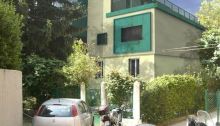
Housing | Detached house
Private client, Bologna. Requalification. Preliminary, final and working plan (in collaboration with Claudio Trombetti). Bologna, 2007-2010
Private client, Bologna. Requalification. Preliminary, final and working plan (in collaboration with Claudio Trombetti). Bologna, 2007-2010
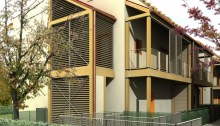
Costruire srl. 16 houses units’ building. Working plan (in collaboration with Giuseppe Satta). Faenza, 2008-2011 Web site: http://www.costruirefaenza.it/

Costruire Srl. 10 dwelling Housing building in Vergato. Preliminary, final and working plan (in collaboration with Giuseppe Satta). Vergato (Bologna), 2005-2009 Web site: http://www.costruire.bologna.it/
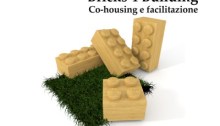
“Bricks 4 Building – Co-housing e facilitazione” vuole essere un’agile guida introduttiva ai metodi di facilitazione applicati al Co-housing con particolare attenzione all’applicazione del metodo LEGO® SERIOUS PLAY® in tale contesto. L’insieme di queste proposte nasce dall’incontro tra Patrizia Bertini, facilitatrice certificata LEGO® SERIOUS PLAY® e ricercatrice indipendente, e Carlo Bughi, architetto, che ha conosciuto…
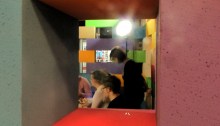
[Paesaggio Urbano |Urban Design, #5-6.2013, Maggioli Editore ] Download PDF [ 422 Kb] >> Into the bricks_Bughi Balancing Material, Colour and Light in a LEGO inspired stand for meetings, workshops and interviews at Restauro 2013 Realising a LEGO inspired stand is not probably a new idea. On the contrary, the project’s genesis is authentically original, stemming…
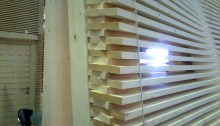
Wood Wide Wall’s design stems from another industrial product: finishes are made using plane timber profiles, ventilated facades or floors. This project uses a sole industrial profile, produced by MakHolz, with a 19×115 section, sized in only three measures. The designing principle is based on the mere boards’ juxtaposition one over the other and all…

“Building’s design is becoming much more integrated: beside shapes and functions, components’ design is gaining more attention because of its impact related to optimization practices in cutting, working, transportation and installation. All these processes are well illustrated in timber buildings. This article presents two examples, two small scale projects, of the afore mentioned design and…
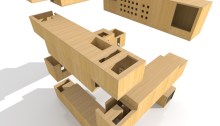
Qasbaum is a modular building system designed for a broader concept of contemporary living including residential, hospitality, and co-working spaces in regeneration projects. Qasbaum comes from Qasbah + baum (wood in German) because it translates the Kasbah’s main features (comfort, security, privacy) into a modular system entirely realized with XLAM technology which is common in…
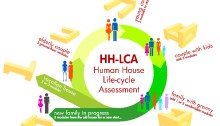
LCA, Life-cycle assessment (also known as life-cycle analysis, ecobalance, and cradle-to-grave analysis) is a technique to assess environmental impacts associated with all the stages of a product’s life from-cradle-to-grave (i.e., from raw material extraction through materials processing, manufacture, distribution, use, repair and maintenance, and disposal or recycling). [read more: wikipedia >>] Such a concept can be applied to Qasbaum’s modules, when…
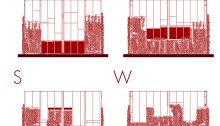
Qasbaum’s plans Today the idea of a living module is recurring and it requires to take into proper consideration industrial processes, logistic organization, the limits of the ordinary transport systems and, not at least, the living comfort. The typical architectural responses to such a challenge consist in two opposite living concepts: the single house (happily…
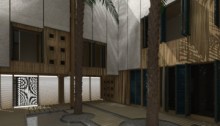
Qasbaum originates from two well-known concepts. The first one is the “Qasbah” (or Kasbah), the typical tower house in Arabic countries that identifies those urban aggregates characterised by inner courts, narrow streets and substantially blind façades toward the external side. These mentioned Kasbah’s features are part of a strategic defensive approach in an area in which…
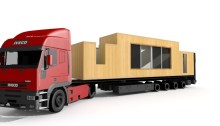
Qasbaum considers all ordinary transport conditions, unlike the US house movers. The transition between two phases implies both components first, and than modules, to be transported. XLAM panels are the most outsized elements in the “assembly kit”. To ensure a complete transportability of each element, Qasbaum avoids to use panels dimensioned like a whole wall, because a…
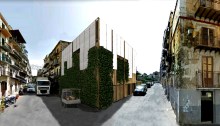
To emphasise the features of Qasbaum 01, a simulation places it in a working-class area situated in the historical centre in a Southern Italy city. Qasbaum 01 fills up an empty space, probably inherited by the Second World War bombings, now occupied by neglected warehouses. This location, potentially prestigious because it’s 300 meters from the sea, is…

The modules’ size matches those of standard containers to optimise the transport causes. In Qasbaum each module is equivalent to a living space (a bedroom, a kitchen, a living room, a study, etc). Therefore, each living space is not wider than 2,50 meters and not longer than 12.5 meters bringing the internal spaces to a…
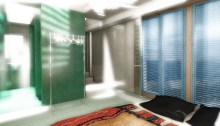
A single bedroom (Module n° 4, second level) Inner finishings are essential. The larger part of the walls are cladding-free, except where wiring and pipes need to be hidden . Colours’ lightness is generally high to enhance the natural light’s diffusion, and with cool hues, whereas saturation could be both low (in the main spaces not…

[Paesaggio Urbano |Urban Design, #5-6.2012, Maggioli Editore ] The coming of BIM (Building Information Modelling) was expected like a mystical event. It’s since 1999 that BIM is discussed in the US. As revealed in a number of studies and research performed by many universities, even Italian ones, in Italy, as well as in Europe, designers,…

To summarise my experiences, I’ve created an “interactive” portfolio, with my skills, an overview of my activity (INDEX), and detailed case studies focused on Communication, e-magazine & multimedia, Corporate identity, Book, Contents & Catalogues, Events & Multimedia. In these pages, the pictures above the timeline are linked to “postcards” with a detailed description of my…
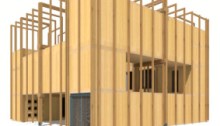
The Qasbaum’s realization process consists of three distinct phases: The Production of each single component (walls, floors, pillars, beams, doors, flooring, staircases, fixtures, etc.). More than in the ordinary building process, the places of production can be located in several countries because each component will converge not directly to the building site, but to a…
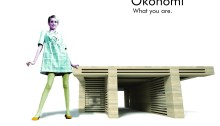
Okonomy, designed by Carlo Bughi, 2014 No glue employed | 296 wooden boards | 0,56 m³ of wood | 2 main configurations | 5 species employed: Picea Abies, Abies Alba, Larix decidua, Fraxinus, Fagus Sylvatica
 Carlo Bughi | Architect